Anyone who has been through a medical consultation knows how much information needs to be captured: the chief complaint, how long the symptoms have lasted, past medical history, examination findings, initial impressions, and possible treatment plans.
These details are essential for diagnosis and care, but they are also time-consuming to organize. In integrated Western medicine and Traditional Chinese Medicine workflows, the documentation burden can be even heavier. A clinician may need to record conventional medical history and physical findings, while also preserving TCM-specific reasoning such as four-diagnostic synthesis, syndrome differentiation, and treatment principles.
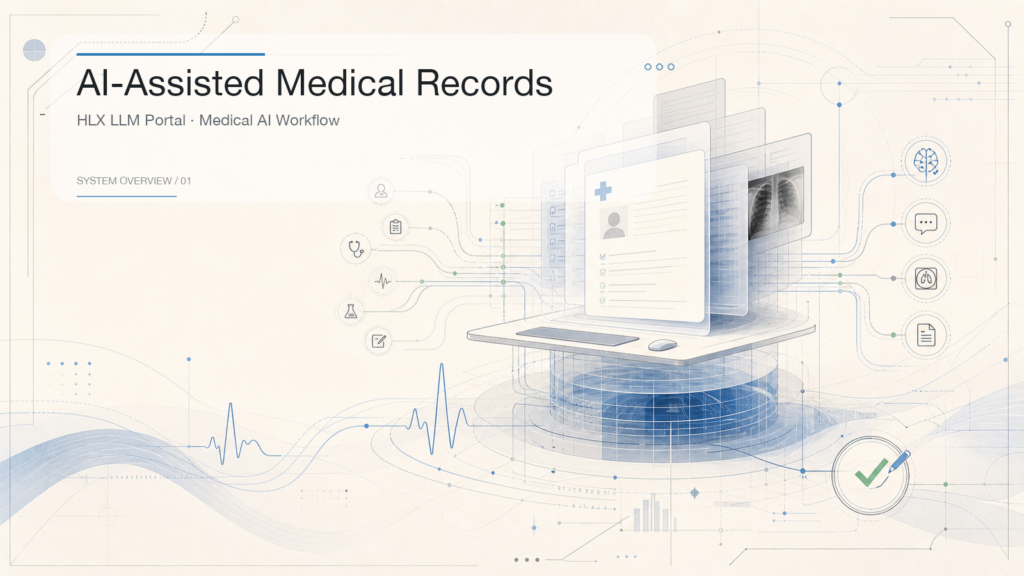
HLX LLM Portal is designed for exactly this kind of workflow.
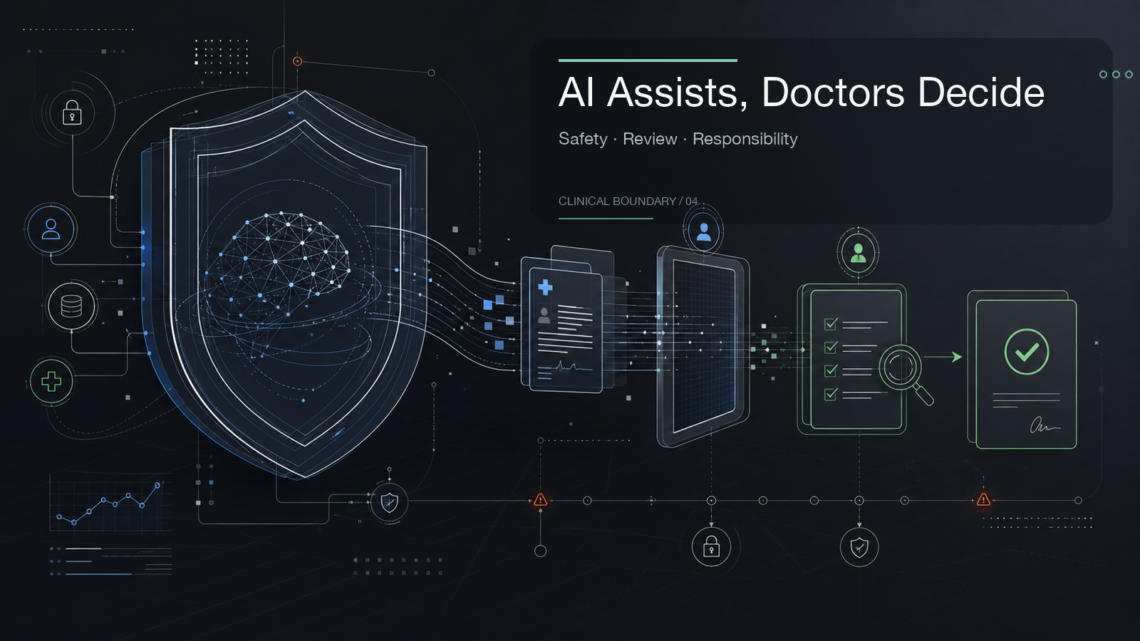
Its goal is not to replace doctors. Instead, it brings large language models into the process of consultation, diagnosis support, and medical record preparation, so that AI can help generate structured drafts that clinicians review, edit, and confirm.
In practical terms, HLX LLM Portal is best understood as a medical AI front-end and orchestration layer. It connects clinician input, prompt templates, text-based LLM services, vision-language model services, and document export into one working interface.
The Short Version
HLX LLM Portal is a Next.js-based medical AI front-end. It brings several related functions into one system:
| Module | What It Does |
|---|---|
| System entry page | Provides a unified entry point for diagnosis, text chat, image chat, and template management |
| Guided diagnosis workflow | Collects clinical information step by step and generates diagnosis, treatment plan, and record drafts |
| Text LLM chat | Sends user questions to a configured medical language model endpoint |
| Medical image chat | Lets users upload an image and ask a vision-language model questions about it |
| Template management | Allows administrators to edit the prompt templates used in the workflow |
The value of the system is not merely that it has a chat box. Its real value is that it places AI inside a structured medical documentation workflow.
It Is Not the Model. It Is the Control Desk.
When people see an AI product, they often assume the model is built directly into the application. HLX LLM Portal works differently.
The application itself does not train or run a large model. Instead, it coordinates the flow of information:
- It collects clinical information from the user.
- It inserts that information into predefined prompt templates.
- It calls locally or internally configured LLM and VLM services.
- It displays the model output in the interface.
- It allows the user to review, edit, confirm, and export the result as a Word document.
In other words, the portal is a medical AI operation interface. The actual text generation and image understanding are handled by external model services.
Clinician enters clinical informationFront-end workspacePrompt templatesText LLM serviceMedical image uploadVision-language model serviceDiagnosis and treatment draftImage-based responseClinician review and editingWord document export
This architecture keeps the front-end relatively lightweight. It also means that different hospitals, teams, or deployments can connect their own model services behind the same workflow.
Guided Diagnosis: Breaking a Complex Record into Clear Steps
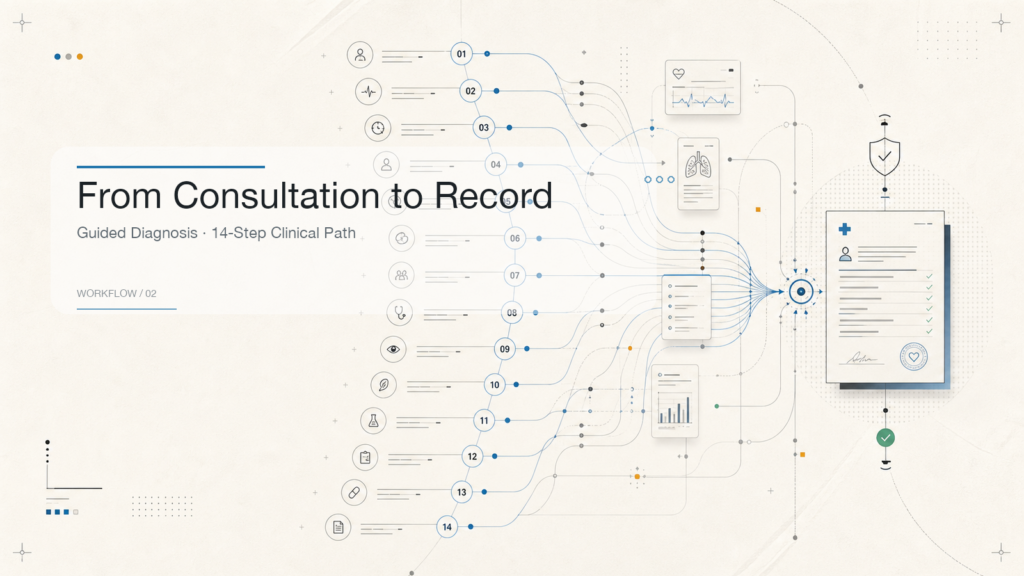
Medical documentation fails easily when information is missing or poorly structured. HLX LLM Portal addresses this by turning record generation into a step-by-step workflow.
The diagnosis page moves through stages such as:
- Chief complaint
- History of present illness
- Past medical history
- Personal history
- Menstrual history
- Marital history
- Family history
- Physical examination
- Specialist examination
- Four-diagnostic synthesis
- Auxiliary examination
- Preliminary diagnosis
- Treatment plan
- Medical record generation
This mirrors how clinicians actually work: first gather the basic complaint, then complete the patient history, add examination findings, form a diagnostic impression, and finally prepare a treatment plan and medical record.
In this workflow, AI does not skip clinical judgment. Its role is to help with text organization and draft generation. For example, after a clinician enters the chief complaint and history, the system can use a template to generate a more complete and standardized history of present illness. In the final stage, it can produce a structured draft record for review.
Why Prompt Templates Matter
A casual user might ask an AI system, “Write a medical record for me.”
That is not precise enough for clinical work. Medical records have structure, diagnosis requires discipline, and each stage of documentation has its own language and expectations.
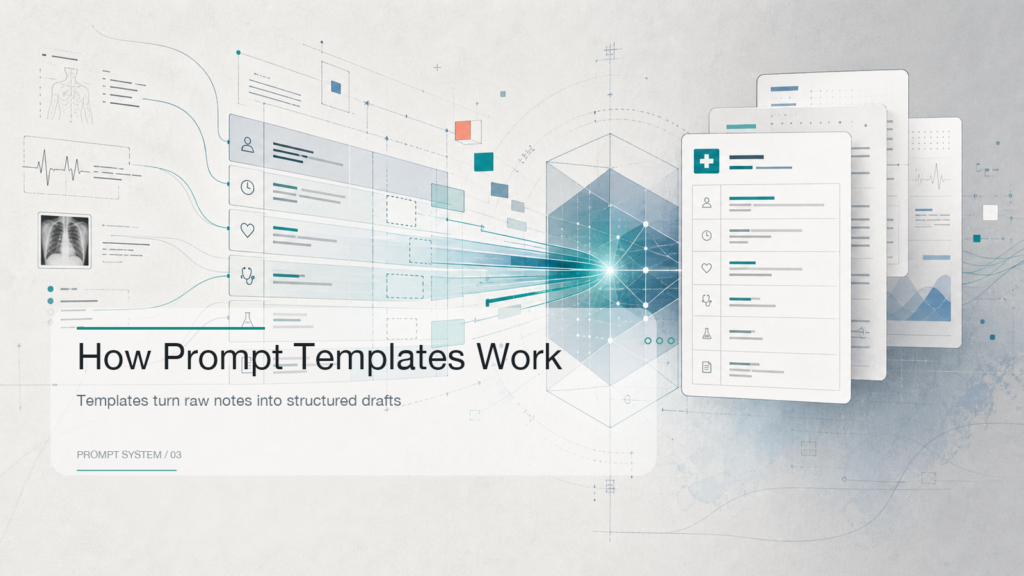
HLX LLM Portal uses prompt templates to make model output more consistent. A template contains rules and instructions, then fills in user-provided clinical details.
| User Input | What the Template Helps With |
|---|---|
| Chief complaint | Guides the model to rewrite it in standard medical language |
| History of present illness | Asks the model to organize the details in a clinical record style |
| Examination findings | Helps the model summarize findings in relation to diagnosis |
| TCM-related information | Guides the model to generate syndrome differentiation and treatment-related text |
This makes the output more stable and easier to adapt to different departments, hospitals, or documentation styles.
The system also includes a template management page. Administrators can edit the prompt templates used by the diagnosis workflow, which means the model’s “working instructions” are configurable rather than hard-coded.
Text Chat vs. Image Chat
HLX LLM Portal includes two kinds of AI interaction.
The first is text-based LLM chat. A user enters a question, and the application sends it to the configured LLM endpoint. This is similar to a standard AI chat interface, but it can be connected to a local or internal model service.
The second is medical image chat. A user uploads an image and asks a question about it. The system sends both the text prompt and the image data to a configured vision-language model service.
In simple terms:
| Mode | Input | Output |
|---|---|---|
| Text LLM chat | Text question | Text response |
| VLM image chat | Image plus text question | Text response based on the image |
Together, these two modules allow the portal to support both written medical information and image-assisted interpretation workflows.
What Can It Export?
The system can export generated treatment plans and medical record content as Word documents.
That matters because AI-generated content should not remain trapped inside a web page. In real clinical and administrative workflows, documents often need to be edited, reviewed, archived, shared, or integrated into existing processes. Exporting .docx files makes the generated drafts much more usable.
How It Is Built
From a technical perspective, HLX LLM Portal is a modern web application:
| Technology | Role |
|---|---|
| Next.js | Front-end pages and selected API routes |
| React | Interactive user interface |
| TypeScript | More reliable application code |
| Bootstrap | Layout and visual styling |
| docx / file-saver | Word document generation and download |
| react-dropzone | Drag-and-drop medical image upload |
| OpenAI client library | Optional compatibility path for certain LLM services |
The main pages include the system entry page, diagnosis workflow, text chat, image chat, template editor, and login page.
Architecturally, the most important idea is orchestration. The application connects several capabilities into one workflow without pretending to do everything by itself.
What Must Be Handled Before Real Deployment?
For a demo, a system like this can be straightforward to run. For real clinical use, the bar is much higher.
Several issues need careful attention:
- Internal endpoint URLs, administrator credentials, API keys, and other sensitive values should not be hard-coded in configuration files.
- Administrator login should not rely on weak default credentials.
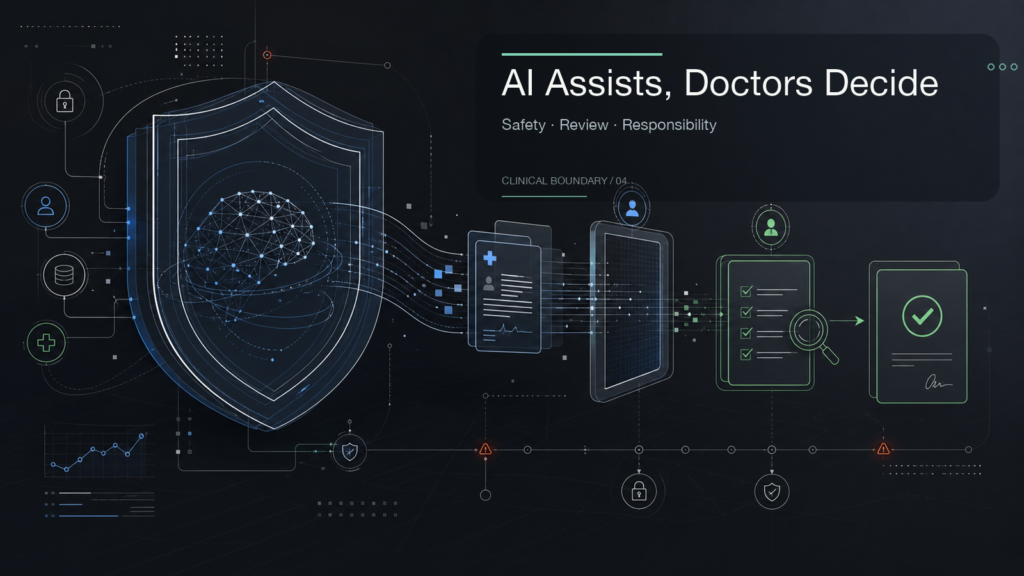
- Diagnosis and treatment content generated by models must be reviewed by qualified clinicians.
- The current system does not provide full patient-data persistence, access auditing, encryption at rest, or enterprise-grade compliance controls.
- The template editor writes directly to the prompt template file, so access must be restricted in shared or production deployments.
These are not minor details. Medical AI systems deal with sensitive health information. Even when the system is “only” assisting with documentation, it still needs serious handling of permissions, logs, encryption, auditability, and responsibility boundaries.
What Problems Is It Well Suited For?
HLX LLM Portal is well suited for:
- Helping clinicians organize consultation information.
- Turning fragmented notes into standardized medical language.
- Generating diagnosis and treatment drafts from fixed templates.
- Producing editable treatment plans.
- Exporting AI-assisted content into Word documents.
- Connecting text LLMs and vision-language models in one interface.
It should not be understood as:
- An automatic diagnosis system.
- An automatic prescribing system.
- A tool that bypasses clinician review.
- A production-ready clinical compliance platform by default.
That distinction is essential.
A More Accurate Positioning
A concise way to describe HLX LLM Portal is:
An AI front-end orchestration platform for medical documentation and diagnosis-support workflows.
It takes a familiar clinical documentation process and breaks it into manageable steps. At each step, AI helps generate or organize text, while the clinician remains responsible for judgment, correction, and final approval.
Its purpose is not to replace doctors. Its purpose is to reduce repetitive writing, improve drafting efficiency, and let clinicians spend more attention on reasoning, communication, and care.
Final Thoughts
The hard part of applying AI in medicine is not simply getting a model to answer a question. The hard part is placing the model inside a real workflow where information is structured, outputs are reviewable, and responsibility remains clear.
HLX LLM Portal points in that direction. It is not just a standalone chatbot. It embeds AI into consultation, diagnosis support, treatment planning, medical record generation, and prompt-template management.
If future versions further strengthen authentication, security, auditing, data protection, and clinical review mechanisms, this kind of system could become a more practical medical AI workbench.
Until then, its most appropriate role is clear:
It is a documentation assistant for clinicians, not a doctor itself.